

Employment to Nowhere: How 5,400 Migrants Fell Victim to a Single Gang
27.02.2026
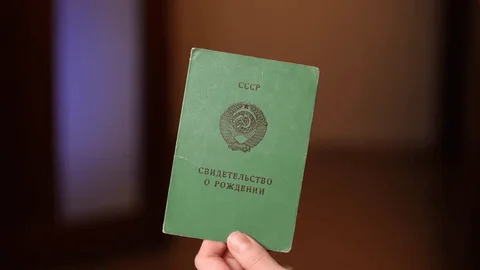
Many people born before 1991 may still have “old-style” documents. For example, a birth certificate. Here is why you might need to obtain a duplicate certificate and how to do it.
When applying for a job or moving to another country, you may need an apostille on your birth certificate to confirm the document’s legality.
A birth certificate issued back in the USSR era can wear out over time — damage or marks may appear, stamps become blurred, and it becomes impossible to see exactly what is written inside the seals. “Poor condition” is a serious reason to replace the document. Therefore, when submitting a package of documents for a TRP or PRP, pay attention to this point. ☝️A laminated document is also considered unfit for use.
If you were born in the Soviet era and your birth certificate has a page in Russian in addition to the foreign language, your document may well be accepted by OGiM (Department of Citizenship and Migration) staff, provided that all entries are clearly preserved, there is no blurring, and the text on the seal and the numbers are easily readable. However, this is more of their right than an obligation. This is because USSR forms are outdated, have no security features, and do not meet EAEU (Eurasian Economic Union) requirements.
The OGiM and ZAGS (Civil Registry Office) databases in Belarus have no way to verify the authenticity of such documents. But if they accept it—wonderful. An apostille is not needed.
If the Soviet certificate lacks an entry in Russian (which is quite common), then, like other documents issued in a foreign language, an apostille will have to be placed on it. But here it is worth remembering that an apostille cannot be placed on documents issued before 1991 (the same applies to Soviet marriage certificates and other documents of that time), because a country such as the USSR no longer exists, which any notary will tell you. Therefore, you will have to obtain a modern-style certificate.
To obtain a duplicate birth certificate, you must submit a written application to the ZAGS office at your place of residence or the place of birth registration. It is not absolutely necessary to travel to another country, but it is better to clarify this point locally. One option is to contact the Consulate of your country. Also, in some countries, there is a practice where the ZAGS office, after your application, will send the request to foreign colleagues at the place of your birth registration themselves. They will then issue a duplicate birth certificate and forward it to your country of residence. This mechanism is called “international legal assistance in the sphere of civil status acts.” However, this practice works selectively.
✅Examples where they DO help:
Baltic Countries → Baltic Countries
Latvia, Lithuania, and Estonia exchange such requests among themselves.
EU → EU
For example, a Polish citizen born in France can contact a Polish ZAGS, which will send a request to French colleagues. They will send a duplicate. However, you should expect that the process itself may take several months.
CIS Countries → each other
In this case, a citizen of Kazakhstan born in Russia can submit an application to a Kazakhstani ZAGS—and they will request the Russian ZAGS to issue a duplicate. But when sending an application to another country, you will have to wait several months, up to half a year.
If the record is not found in the archives of the bodies registering civil status acts, it will be necessary to restore them through the court. After a corresponding court decision, you will be able to receive a duplicate birth certificate. To apply to the court, you must obtain a notice of the absence of the corresponding record from the archive.
Yes, you can. If it is legally valid, you can continue to use it.
Recommendation: always clarify whether your specific OGiM will accept your USSR birth certificate. If they do not accept it and tell you to get a new one—immediately clarify if it needs an apostille (in most cases—yes). If you do not have the opportunity to clarify the requirements—play it safe and get a new certificate with an apostille. It is guaranteed to be accepted.
An apostille is placed on a birth certificate indefinitely, and it should be accepted by any government authorities without question.